
Many organizations assume Spanish SEO is simply English SEO translated.
They duplicate their English pages, convert the language, and expect similar results.
The traffic never comes.
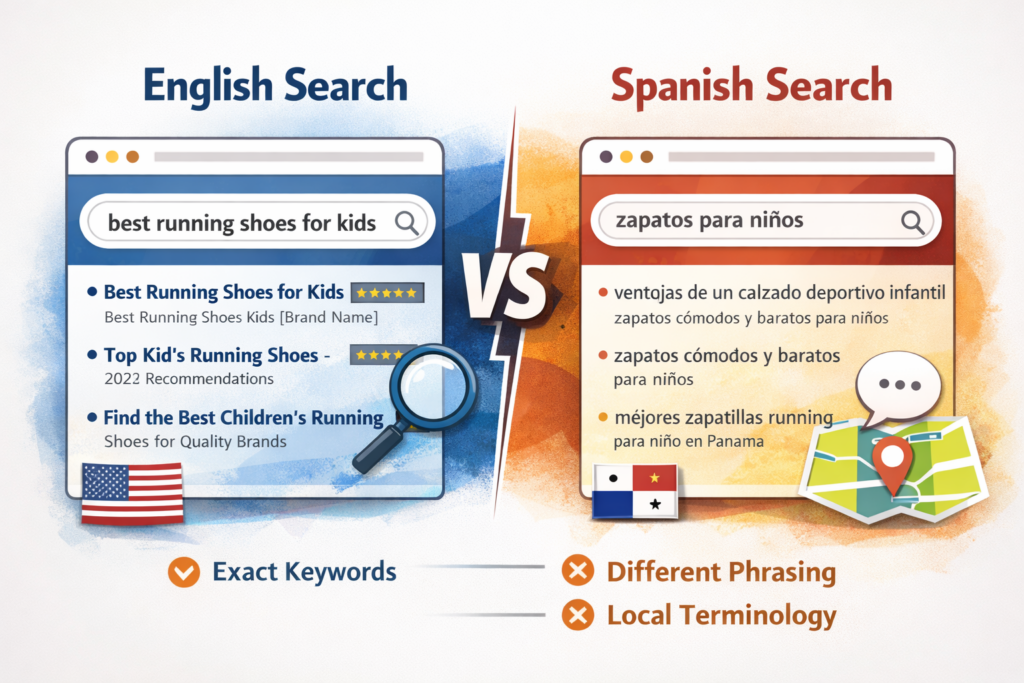
Spanish SEO is not English SEO in another language. It is a distinct behavioral environment shaped by culture, phrasing patterns, intent expression, and regional usage. Treating it as duplication instead of adaptation leads to invisibility.
Different Query Structures
Spanish queries are often longer and more descriptive than English equivalents.
English search behavior frequently favors compressed phrases:
- immigration lawyer
- roof repair
- personal injury attorney
Spanish queries frequently expand:
- abogado de inmigración cerca de mí
- reparación de techos en Houston
- abogado de lesiones personales consulta gratis
Modifiers are not optional. They often carry intent.
Prepositions, pluralization, and word order also matter. A direct English-to-Spanish conversion may technically translate the idea but miss how the query is actually typed into search engines.
Search engines reward alignment with real user phrasing, not literal equivalence.
Cultural Search Differences
Spanish-speaking audiences often search with higher sensitivity to trust, authority, and clarity.
Terms like:
- certificado
- profesional
- autorizado
- confiable
- con experiencia
are not decorative — they signal credibility expectations.
In some industries, tone matters as much as terminology. Overly literal translations can feel stiff, mechanical, or culturally distant. That affects click-through rates and engagement signals, which in turn affect rankings.
Spanish SEO is behavioral psychology expressed through structure.
AEO (Answer Engine Optimization) in Spanish
Answer engines and AI-driven search results are increasingly structured around clear, concise information blocks.
To appear in AI-generated answers in Spanish, content must include:
- Clean heading hierarchy
- Direct response paragraphs
- FAQ sections
- Semantic reinforcement
- Clear entity references
Simply translating English FAQ sections is not sufficient. The questions themselves must reflect how Spanish-speaking users phrase uncertainty.
For example:
English: “How much does roof repair cost?”
Spanish literal: “¿Cuánto cuesta la reparación del techo?”
Actual search variations may include:
- precios reparación de techos
- cuánto cobra un techador
- costo arreglar techo
If the phrasing does not match search patterns, AI engines will not surface the content.
Spanish AEO requires linguistic and structural adaptation.
When Copying English Pages Fails
Many businesses clone their English site architecture:
Same URLs.
Same structure.
Same internal linking.
Same keyword mapping.
Then translate the content line by line.
This creates three common failures:
- Misaligned keyword targets
- Weak internal linking in Spanish
- No regional entity reinforcement
Search engines interpret Spanish pages independently. They are not extensions of English authority by default.
If the Spanish architecture does not stand on its own semantic structure, it will not compete.
Spanish SEO requires its own keyword mapping, entity strategy, and linking structure.

Declarative Summary
Duplicating English SEO into Spanish without behavioral adaptation creates pages that exist but do not compete. Spanish SEO must be engineered as an independent search system, not mirrored as a secondary language layer.
Frequently Asked Questions
Is Spanish SEO just translated English SEO?
No. Spanish SEO requires independent keyword research, structural optimization, and alignment with Spanish-language search behavior. Direct translation does not account for regional phrasing or intent modifiers.
Why doesn’t my translated Spanish page rank?
Common causes include literal keyword translation, lack of regional optimization, missing Spanish internal links, and weak semantic alignment.
Do Spanish users search differently?
Yes. Spanish queries often include more context, longer phrasing, and trust-oriented modifiers. Search patterns vary by region and industry.
Does AI treat Spanish pages differently?
AI-driven search systems rely on structured content, query alignment, and clarity. Spanish pages must reflect real Spanish-language search phrasing to be included in AI responses.
Closing
Spanish SEO is not duplication.
It is adaptation.
If your Spanish content is structured as a translated copy of English pages, it will behave like a copy — secondary and rarely surfaced.
Spanish must be built as infrastructure.
If your organization is serious about Spanish visibility, the work begins before translation.