
The Conversion Gap Between English and Spanish Pages — And What It’s Really Costing You
English pages generate steady inquiries while Spanish pages attract traffic yet produce fewer calls, fewer form submissions, and weaker engagement. The disparity often hides inside aggregated reporting because performance data rarely receives side-by-side comparison by language. Without isolating metrics, the revenue gap expands month after month beneath otherwise stable growth charts.
The Conversion Gap Between English and Spanish Pages
A bilingual website operates as two acquisition systems running in parallel. When conversion rates are evaluated independently, structural differences frequently emerge. An English service page converting at four percent may have a Spanish equivalent converting at one percent under comparable traffic conditions. The margin appears manageable in isolation. Scaled across visitor volume and multiplied by contract value, the financial implications become substantial.
Revenue derives from a simple equation: qualified traffic multiplied by conversion rate multiplied by deal value. A decline in conversion performance within the Spanish ecosystem reduces total revenue capacity. Thirty missed leads per month compounds into hundreds across a fiscal year. For professional services operating at meaningful price points, the cumulative gap can approach six or seven figures without ever appearing as a single line item on a report.
Spanish Traffic Without Proportionate Sales
Traffic volume alone does not produce revenue. Engagement and perceived authority determine whether visits translate into inquiries.
Spanish-language visitors often demonstrate shorter session duration and reduced interaction on underperforming pages. Vocabulary may be accurate, yet structural fluency may remain absent. Sentence hierarchy can reflect English logic rather than natural Spanish cadence. Headings may mirror translated keywords rather than authentic search phrasing. Calls to action may carry persuasive assumptions shaped by English-speaking markets instead of culturally attuned positioning.
Each of these elements influences perception subtly. Perception influences trust. Trust influences conversion.
Revenue dissipates through structural friction rather than dramatic failure.
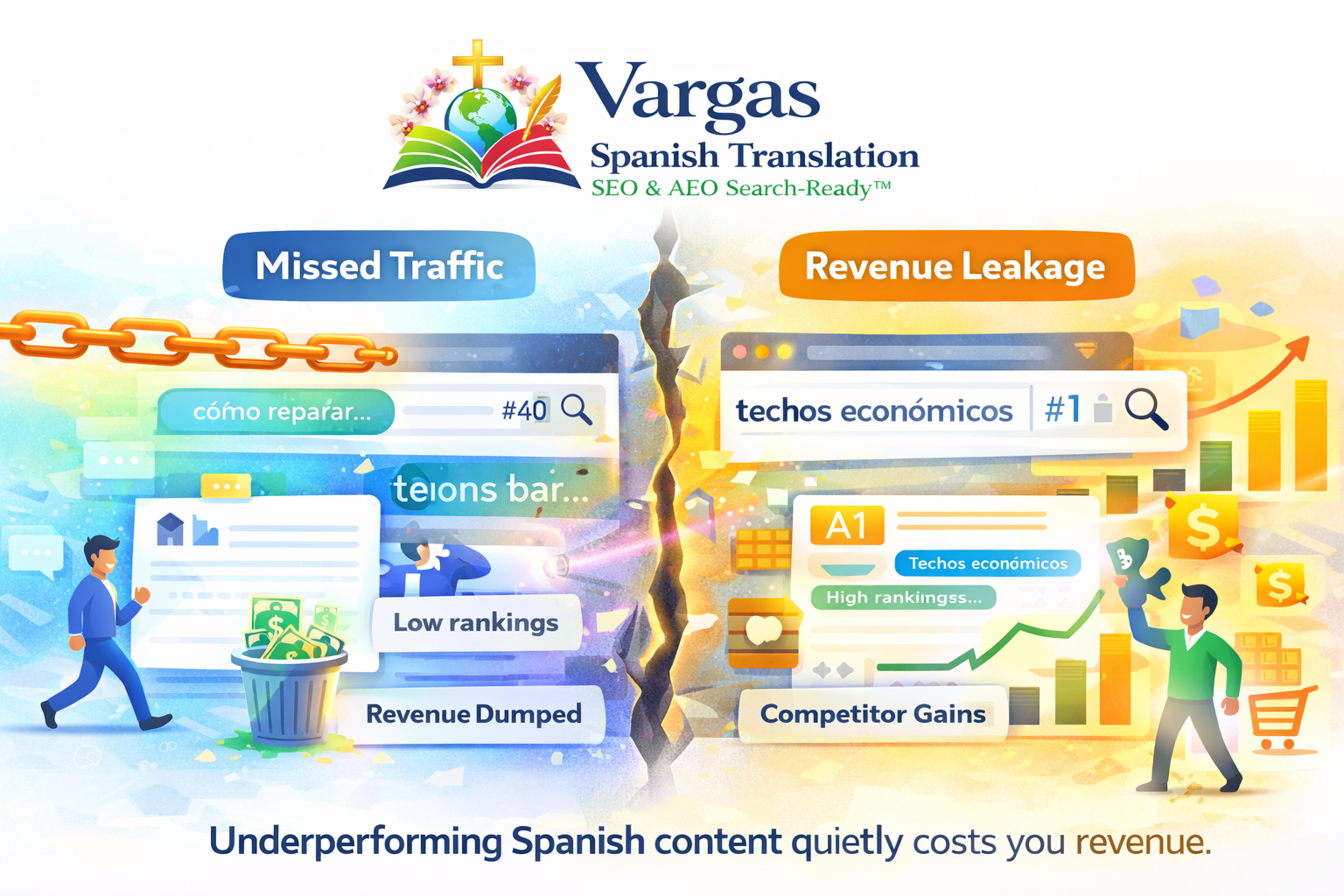
Visibility and Revenue Move Together
Conversion performance depends on traffic quality as much as traffic quantity. Spanish search behavior differs from English patterns in modifier placement, query expansion, and intent signaling. Literal translation of English keywords frequently overlooks those distinctions.
Independent Spanish keyword research often receives less strategic depth than English mapping. Without query-aligned architecture, entity reinforcement, and consistent internal linking in Spanish, pages struggle to establish authority in search ecosystems. Visibility fluctuates. Lower-intent traffic fills the funnel. Conversion rates weaken further.
Search engines incorporate engagement signals into ranking systems. Pages that generate shorter dwell time and reduced interaction gradually lose positioning stability. Reduced visibility limits qualified traffic, reinforcing the cycle of underperformance.
Revenue declines upstream through weakened visibility and downstream through lower conversion strength.
The Compounding Effect Over Time
Underperformance rarely feels urgent at first. A modest difference in monthly lead volume blends into broader performance trends. Over extended periods, the cumulative impact becomes measurable.
One thousand Spanish-language visitors per month converting at one percent yield ten leads. The same traffic converting at four percent yields forty. Thirty leads disappear monthly through structural inefficiency. Across twelve months, that represents three hundred sixty unrealized opportunities.
At an average contract value of two thousand dollars, the annual revenue difference approaches seven hundred thousand dollars. Higher-value industries amplify the disparity even further.
Market demand remains present. Infrastructure constrains capture.
Misreading Market Behavior
Weaker Spanish performance often receives attribution to assumptions about audience behavior. A narrative forms suggesting that Spanish-speaking consumers convert at lower rates. Competitive analysis across high-performing bilingual organizations points toward a different explanation.
Spanish content aligned with native phrasing, culturally grounded authority signals, and independent search behavior mapping achieves conversion rates approaching English benchmarks. Structural alignment narrows the gap. Misalignment widens it.
Assumptions about demographic conversion tendencies obscure architectural inefficiencies.
Structural Drivers of Revenue Leakage
Language shapes perceived expertise. Expertise shapes conversion behavior. Structural design determines how language performs within search ecosystems.
Underperforming Spanish pages frequently exhibit mirrored English architecture without independent optimization, headings translated rather than constructed around Spanish search queries, inconsistent terminology across service sections, internal linking pathways favoring English content, and persuasive frameworks calibrated to English norms rather than Spanish-speaking expectations.
Individually, these patterns appear minor. Collectively, they establish a ceiling on performance.
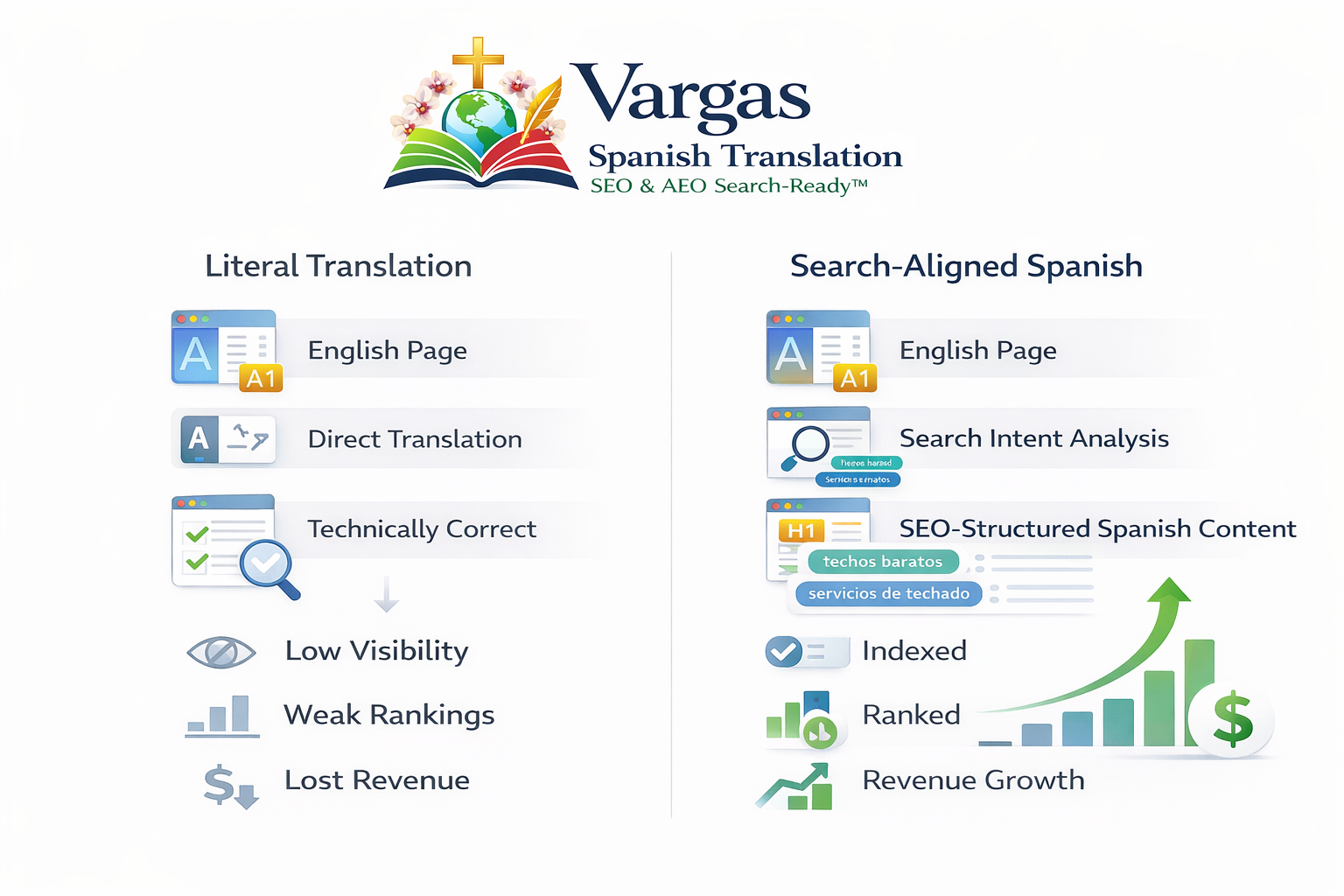
Spanish optimized solely for grammatical accuracy meets linguistic standards. Spanish engineered for acquisition integrates keyword behavior, structural clarity, cultural nuance, and search intent alignment from inception.
Spanish as Revenue Infrastructure
A revenue-focused Spanish strategy treats language as an independent acquisition engine. Independent keyword mapping precedes drafting. Headings reflect authentic Spanish search phrasing. Service terminology remains consistent across the Spanish ecosystem to reinforce entity clarity. Internal linking connects Spanish pages into a cohesive topical network rather than isolating them as translated replicas.
Structural alignment strengthens visibility, engagement, and conversion simultaneously. Improved engagement stabilizes ranking. Stable ranking increases qualified traffic. Qualified traffic enhances conversion performance. Conversion performance supports revenue growth.
Spanish evolves from symbolic inclusion into measurable infrastructure.
The Financial Standard for Bilingual Performance
A bilingual website contains two revenue systems operating in parallel. Comparable structural precision should produce comparable performance across language segments. Disparities indicate opportunity rather than inevitability.
Underperforming Spanish content rarely announces its cost. It manifests through suppressed conversion rates, weaker engagement signals, and diminished ranking stability. Financial impact accumulates quietly until direct comparison reveals scale.
Expansion into Spanish-speaking markets provides access to one of the largest and fastest-growing consumer segments in the United States. Structural precision determines whether that access translates into realized revenue or remains theoretical growth potential.
Hi~(* ̄▽ ̄*)
Honestly, it’s really good
So,I like it
I like this
https://addlinks.pro/LVlZ0
An Engaging Blog Post