
Organizations often point to their Spanish pages with confidence. The translation was handled professionally. The grammar is accurate. The terminology is correct. The tone reflects the brand. On review, nothing appears wrong.
And yet the page produces nothing measurable.
It does not appear for relevant searches. It attracts no qualified traffic. It generates no inquiries. It earns no citations in AI-generated answers. Internally, the conclusion is often the same: “We tried Spanish. It didn’t work.”
The truth is less convenient.
The Spanish did not fail. The structure did.
Accuracy Is Not Visibility
Most translation providers are hired to convert language faithfully. Their responsibility is linguistic integrity. If the English says one thing, the Spanish must say the same thing with precision. In that respect, many vendors succeed.
But search engines and AI retrieval systems do not reward linguistic accuracy. They reward alignment.
Search visibility depends on how content matches real query behavior. It depends on how headings reinforce intent. It depends on how topics are structured, supported, and internally connected. It depends on whether the language reflects how Spanish-speaking users actually search.
A page can be flawless in grammar and still invisible in practice.
Accuracy ensures the message is correct. Alignment determines whether the message is found.
Those are not the same discipline.
The Illusion of Completion
The most dangerous moment in Spanish content development is publication. Once a page is live, it feels finished. The work appears complete. The organization moves on.
But publication does not equal positioning.
If the Spanish page was built from literal keyword translations rather than behavioral analysis, it may not correspond to any real search pattern. If the structure mirrors the English page without adaptation, it may fail to match Spanish-language query modifiers. If headings are translated instead of engineered, the page may never surface for high-intent searches.
From the outside, the content looks polished.
From the inside of a search engine, it looks irrelevant.
That gap between appearance and performance is where investment quietly disappears.
How Spanish Search Behavior Differs
Spanish-speaking users do not simply translate English searches word for word. Search phrasing shifts based on region, urgency, cultural context, and industry norms. Singular and plural constructions can alter meaning. Prepositions change intent. Localized modifiers influence visibility.
Even small structural decisions—such as the order of terms in a heading—can determine whether a page matches query intent.
When Spanish content is built without mapping these behaviors first, it risks ranking for nothing. The language may be technically correct, yet misaligned with how real people look for services.
Search engines are not evaluating how elegantly a sentence reads. They are evaluating how clearly the page answers a specific query.
If the page does not align with query intent, it does not compete.
The AI Visibility Layer
The shift toward AI-generated answers has made structural alignment even more important. Retrieval systems prioritize clarity, entity reinforcement, topical coherence, and concise answer framing. They select content that directly resolves user intent.
Correct Spanish alone does not guarantee selection.
Content must be structured in ways that AI systems can parse, understand, and cite. Paragraph construction, heading hierarchy, and contextual reinforcement now influence not only ranking but citation eligibility.
Spanish pages built as afterthought translations rarely meet that standard.
The result is silence—not because the Spanish is wrong, but because the system does not recognize it as the best answer.
What Functional Spanish Content Requires
Functional Spanish content begins before translation. It starts with search behavior analysis. What phrases are actually used? How do Spanish-speaking customers describe the problem? What modifiers signal urgency? What regional differences influence wording?
From there, structure is engineered deliberately. Headings reflect search patterns, not literal conversions. Paragraphs are organized around intent clusters. Supporting terms reinforce topical authority. Internal links connect Spanish pages to service infrastructure with semantic clarity.
Only after that foundation is established does linguistic precision matter.
Grammar is the baseline. Visibility is the objective.
Without visibility, correctness has no economic value.
Declarative Summary
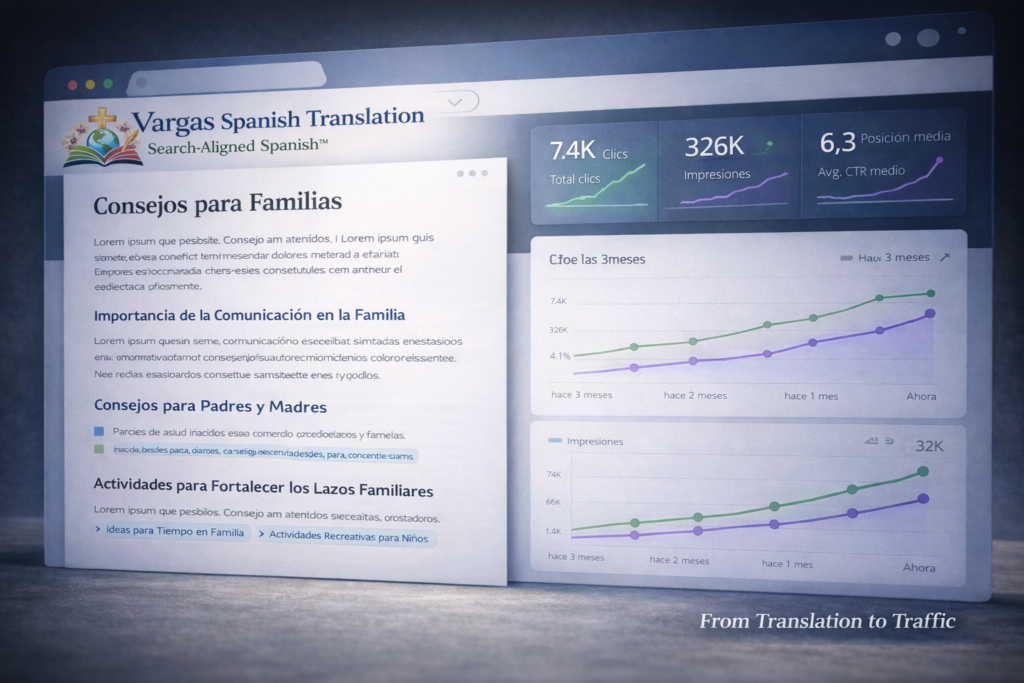
Correct Spanish that no one can find is not an asset. It is an invisible expense. Visibility must be engineered. Alignment must be deliberate. Translation without search structure does not compete.
FAQ
Isn’t professional translation enough for Spanish SEO?
Professional translation ensures linguistic accuracy. SEO and AEO require structural alignment with real search behavior and query intent.
Why would a grammatically correct Spanish page receive no traffic?
Because ranking depends on how well content matches search queries, intent modifiers, and structural signals—not on grammar alone.
Does AI automatically surface well-written Spanish?
No. AI retrieval systems prioritize clarity, structure, and direct answer relevance. Content must be formatted and aligned intentionally to be selected.
What should Spanish SEO translation services include?
Search behavior analysis, intent mapping, structural optimization, entity reinforcement, and strategic internal linking in addition to linguistic accuracy.