
Businesses expanding into Spanish-speaking markets often begin with what seems logical: translate the keywords.
If “roof repair” drives traffic in English, then translating it into Spanish should produce the same result.
It doesn’t.
Literal keyword translation ignores how Spanish-speaking users actually search, how intent is expressed in Spanish, and how search engines interpret regional language patterns. The result is Spanish pages that are grammatically correct — and digitally invisible.
The Myth of Direct Keyword Translation
The assumption behind keyword translation is simple:
English keyword → Spanish equivalent → same traffic.
But search behavior does not operate that way.
Take a basic example:
- English keyword: roof repair
- Literal Spanish translation: reparación de techo
In some regions, users search for:
- reparación de techos
- arreglo de techo
- reparación de tejado
- contratista de techos
- compañía de techos cerca de mí
The literal translation may technically be correct, but it may not reflect how people phrase their queries in specific geographic or cultural contexts.
Search engines rank based on user behavior, not dictionary accuracy.
Direct translation assumes language is mechanical. Search behavior is not.
Spanish Search Behavior Is Contextual
Spanish search patterns are shaped by:
- Region (Mexico, Caribbean, Central America, U.S. Hispanic markets)
- Industry vocabulary
- Formal vs informal phrasing
- Plural vs singular usage
- Long-tail query modifiers
A Spanish-speaking user in Texas may search differently than one in Florida. A professional audience may use different phrasing than a residential consumer.
Pluralization alone can change results:
- abogado de inmigración
- abogados de inmigración
- abogado de inmigración cerca de mí
Intent modifiers matter:
- precios
- servicios
- urgente
- certificado
- profesional
Spanish search queries frequently include more context and specificity than English queries. Literal translation ignores this.
When companies translate keywords without studying search behavior, they build pages optimized for language — not for users.
The Invisible Failure: Pages That Rank for Nothing
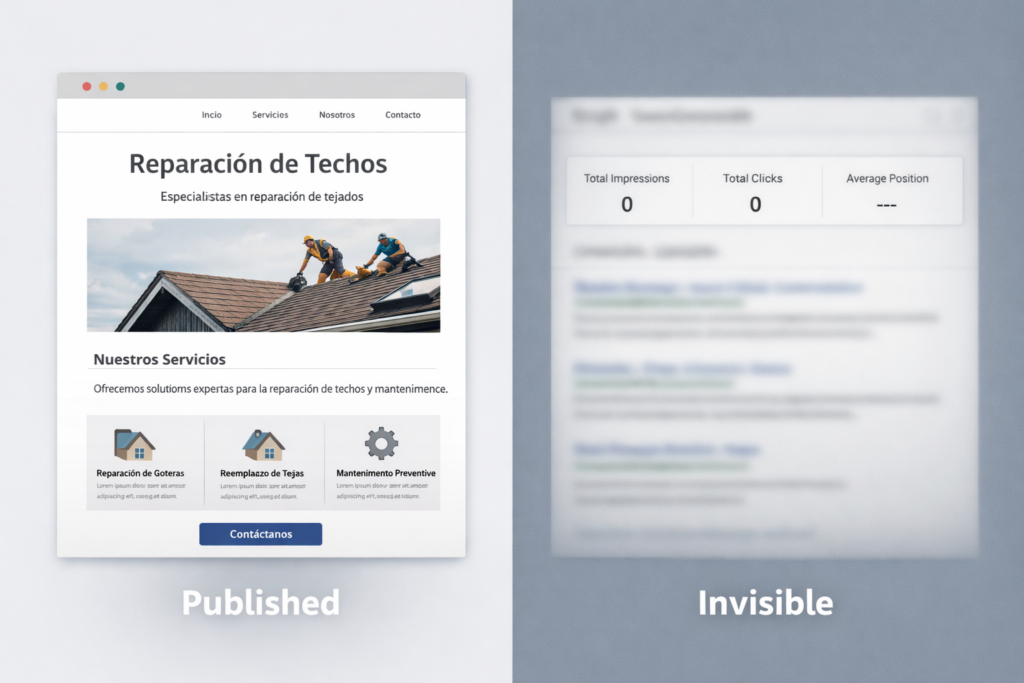
Here is the quietest failure in Spanish digital strategy:
The page is live.
The grammar is correct.
The content reads well.
And it receives no impressions.
No clicks.
No AI citations.
No traffic.
Search Console shows minimal activity. AI answer engines do not surface it. The content exists, but it does not participate in the search ecosystem.
Why?
Because ranking requires alignment across:
- Query phrasing
- Headline structure
- Semantic reinforcement
- Internal linking
- Entity consistency
- Intent clarity
Most translation vendors convert text but do not evaluate search structure. They are language providers — not search strategists.
Correct Spanish without search alignment becomes invisible infrastructure.
What Search-Aligned Spanish Actually Means
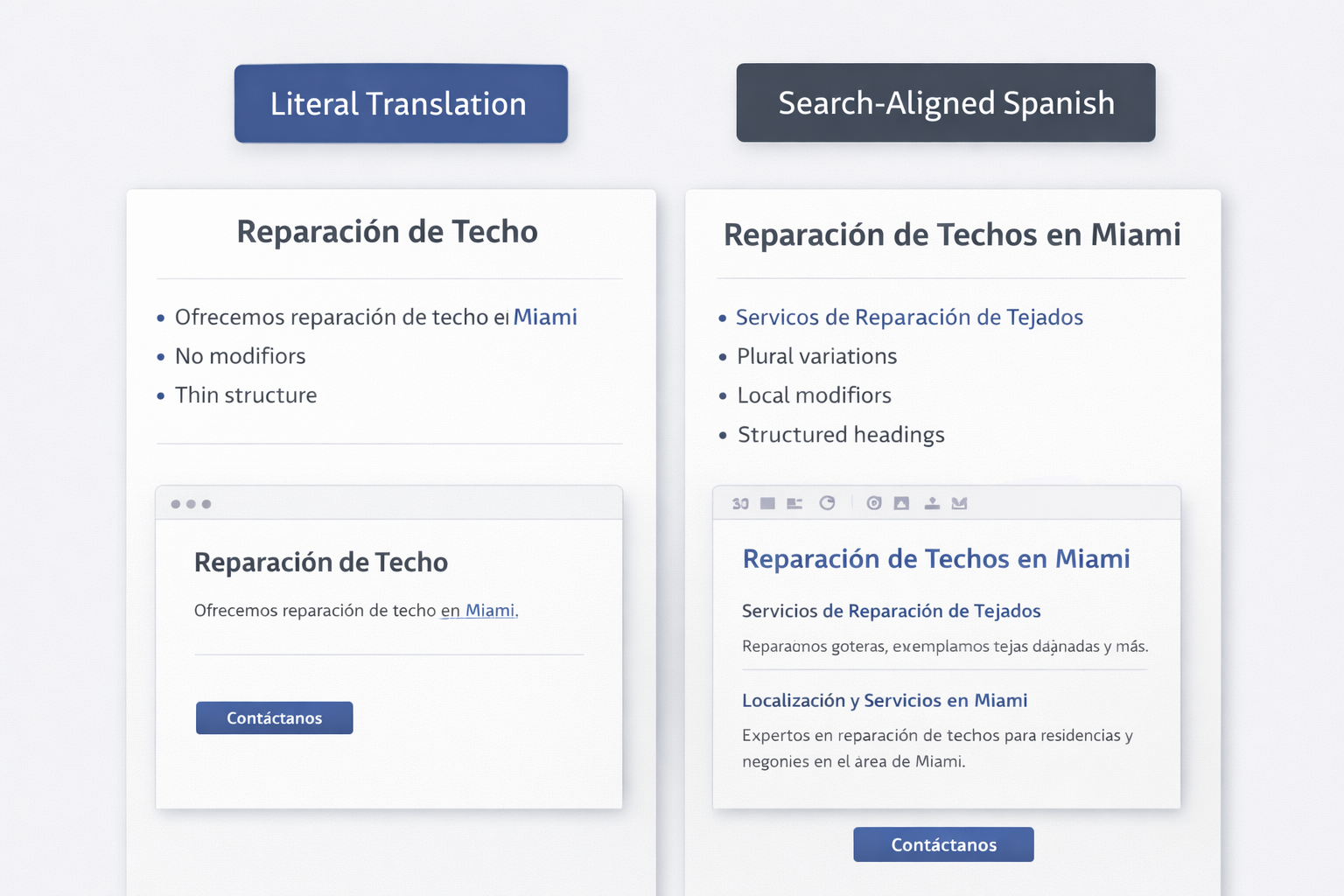
Search-Aligned Spanish begins with behavior, not vocabulary.
It requires:
Behavior-First Keyword Research
Understanding how Spanish-speaking users search within specific industries and regions.
Query-Based Phrasing
Writing headings and subheadings that reflect actual search patterns, not literal translations.
Structural Alignment
Optimizing:
- H1 and H2 hierarchy
- Meta titles and descriptions
- Internal linking
- Schema and FAQ blocks
- Entity reinforcement
Regional Sensitivity
Recognizing that Spanish is not monolithic. Terminology differs across communities.
Search-Aligned Spanish treats translation as operational infrastructure, not linguistic conversion.
This approach aligns with how Vargas Translation Services structures its Spanish SEO Translation Services, ensuring that language supports visibility, credibility, and performance — not just readability.
(Internal link suggestion: link “Spanish SEO Translation Services” to your Services page.)
Declarative Summary
If Spanish content is translated but not structured for search behavior, it does not function as marketing infrastructure. It becomes decorative copy — technically correct and commercially silent.
Frequently Asked Questions (AEO Section)
Does translating keywords into Spanish improve SEO?
Not necessarily. Literal keyword translation often fails because Spanish-speaking users phrase searches differently. Effective Spanish SEO requires behavior-based keyword research and structural optimization.
Why don’t my Spanish pages get traffic?
Common reasons include:
- Literal keyword translation
- Lack of regional phrasing alignment
- Poor heading structure
- No schema or FAQ formatting
- No internal linking strategy
Correct grammar alone does not produce visibility.
Is Spanish SEO different from English SEO?
Yes. Spanish search behavior differs in phrasing, modifiers, and intent expression. Effective Spanish SEO adapts structure and language to match those behavioral patterns.
What is Search-Aligned Spanish?
Search-Aligned Spanish is Spanish content engineered around actual user queries, search intent, and structural SEO best practices. It prioritizes discoverability and trust alongside linguistic accuracy.
Final Thought
If your Spanish pages are live but invisible, that is not a translation problem.
It is an alignment problem.
And alignment determines whether Spanish functions as language — or as revenue infrastructure