
A company launches its Spanish pages with confidence. The grammar checks out. The sentences flow. The terminology matches the English site. Weeks pass. Traffic remains thin. Engagement feels soft. Conversions lag behind the English version by a margin that feels larger than chance.
Nothing dramatic happens. No complaints arrive. No public criticism appears. The Spanish pages simply underperform.
That pattern repeats across industries. Legal firms. Medical practices. Regional contractors. Nonprofits. Agencies serving multilingual markets. The content exists. The investment has been made. Yet the Spanish side never becomes an engine of growth. It sits on the site like a polite afterthought.
Poor Spanish translation rarely creates a scene. It creates hesitation.
The Silent Erosion of Credibility
Spanish-speaking visitors form impressions quickly. They scan tone before they analyze vocabulary. They sense structure before they evaluate terminology. When phrasing carries the weight of English syntax underneath it, the page feels translated rather than written. When rhythm sounds mechanical, the brand feels distant. When word choice lands technically correct yet culturally off-center, confidence slips.
That shift happens in seconds.
A visitor reads the first paragraph and registers subtle friction. The language feels slightly stiff. The register feels slightly misaligned. The message sounds as if it traveled through a filter before arriving. The reaction rarely reaches conscious articulation. It shows up as a shorter session. A faster scroll. A return to search results.
Trust drops without announcement.
For organizations expanding into Spanish-speaking markets, credibility operates as the entry ticket. A single layer of linguistic distance signals that the brand stands outside the community it hopes to serve. In competitive sectors—legal, healthcare, financial services—that distance becomes expensive.
Why Accuracy Alone Fails
Most translation vendors focus on correctness. Their mandate centers on faithful rendering of meaning from one language into another. That objective produces grammatically sound text. It produces clarity at the sentence level. It produces content that passes linguistic review.
Business performance depends on something more demanding.
Language in a commercial setting carries behavioral weight. It must reflect how people search, how they describe their problems, how they evaluate expertise, and how they measure authority. Word-for-word fidelity rarely captures that behavioral layer.
A phrase that reads formally correct may carry the wrong tone for a local audience. A service description may mirror English structure rather than the way Spanish speakers naturally frame the same service. A call to action may sound literal rather than persuasive. Each detail feels minor in isolation. Together they form a subtle barrier.
In markets where options abound, subtle barriers cost leads.
The SEO Consequences of Poor Spanish Translation
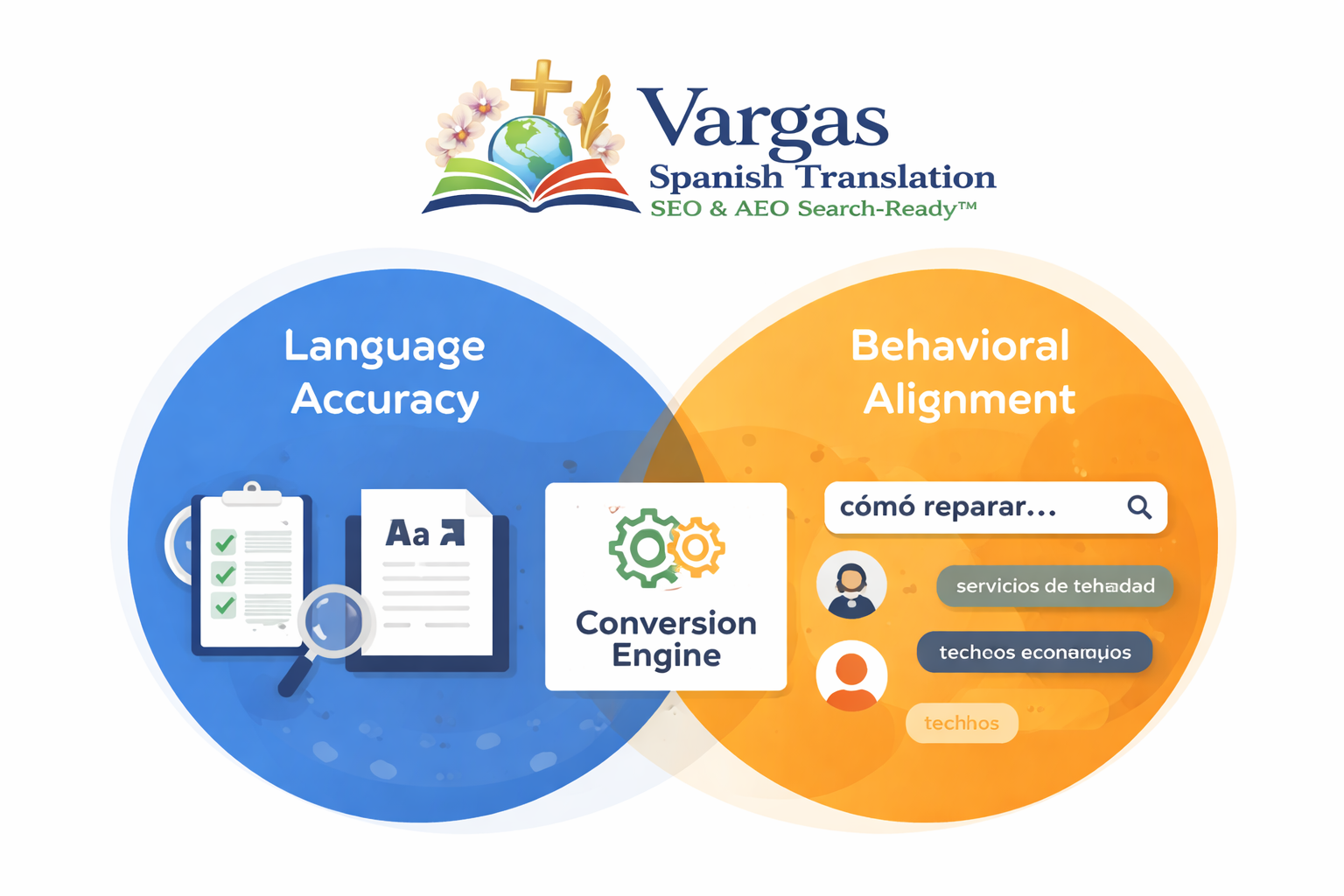
Search engines measure more than keywords. They evaluate engagement, dwell time, clarity of structure, entity consistency, and alignment with query intent. Spanish pages that read stiffly or misaligned tend to generate weaker interaction signals. Visitors spend less time. They engage less deeply. They convert less frequently.
Those behavioral signals shape visibility.
Spanish content that lacks native rhythm often drifts away from real search phrasing. Literal translation of English keywords overlooks how Spanish-speaking users frame their needs. Regional differences, pluralization patterns, and intent modifiers influence discoverability. A page may include technically correct terms while missing the language that people actually type into search bars.
Visibility depends on alignment between phrasing and intent.
When translation treats language as a static dictionary exercise, search performance stalls. Rankings fluctuate. Impressions plateau. AI-generated summaries favor competitors whose Spanish content presents clearer structure and stronger entity reinforcement.
Quality in grammar does not guarantee quality in search performance.
Machine Translation, Cheap Translation, and Structural Weakness
The conversation often centers on machine versus human translation. That framing oversimplifies the issue.
Automated tools produce surface-level fluency at scale. They handle basic communication tasks with speed. In business contexts that demand precision, tone, and strategic positioning, surface fluency falls short. Nuance fades. Industry terminology bends in subtle ways. Cultural positioning flattens.
Low-cost human translation introduces a different risk. The translator delivers accurate language while overlooking search behavior, structural formatting, and performance intent. The result reads polished yet disconnected from how audiences discover and evaluate services online.
Both approaches share a common limitation: language divorced from strategy.
Spanish translation for business requires alignment between message, market behavior, and search infrastructure. Without that alignment, even well-written pages operate below their potential.
The Real Diagnosis: Misalignment
When Spanish pages attract fewer leads than expected, the instinct often points toward advertising budgets or demographic assumptions. The deeper issue frequently lies in structural misalignment.
Language sits at the intersection of trust and discovery. It shapes first impressions. It guides interpretation. It signals belonging. When Spanish content reflects English structure more than native thought patterns, visitors sense distance. When phrasing overlooks regional nuance, it feels generic. When structure ignores how Spanish-speaking users search, visibility narrows.
Misalignment hides inside otherwise competent text.
Correct vocabulary without behavioral awareness creates decorative content. Native rhythm combined with search-aligned structure creates acquisition infrastructure.
The difference shows up in metrics.
What Search-Aligned Spanish Translation Looks Like

Effective Spanish translation for business begins with intent. Before sentences form, the strategy defines who must find the page, how they describe their problem, and what signals establish authority in that sector. The language then mirrors real query patterns rather than dictionary equivalents.
Structure supports performance. Headings reflect how Spanish-speaking users phrase searches. Terminology remains consistent across related pages to reinforce entity recognition. Calls to action sound natural within cultural context. Tone aligns with industry expectations.
Every paragraph serves discoverability and trust simultaneously.
Spanish written in this way does more than read smoothly. It ranks with greater stability. It earns longer engagement. It positions the brand as present rather than translated.
A Strategic Standard
Bad Spanish translation rarely produces embarrassment. It produces underperformance. It limits credibility at the exact moment when credibility determines conversion. It weakens engagement signals that influence search visibility. It slows growth in markets that demand authenticity.
If your Spanish pages exist yet generate uneven results, the issue likely extends beyond grammar. Structural and behavioral alignment determine whether language functions as decoration or as infrastructure.
Spanish should operate as a growth asset.
For organizations ready to treat Spanish as acquisition strategy rather than checkbox translation, structured, search-aligned execution changes the outcome. Services built around SEO and AEO alignment integrate language with performance from the outset.
When Spanish sounds native, matches search behavior, and reinforces authority, the quiet erosion stops. Growth begins where trust meets visibility.